
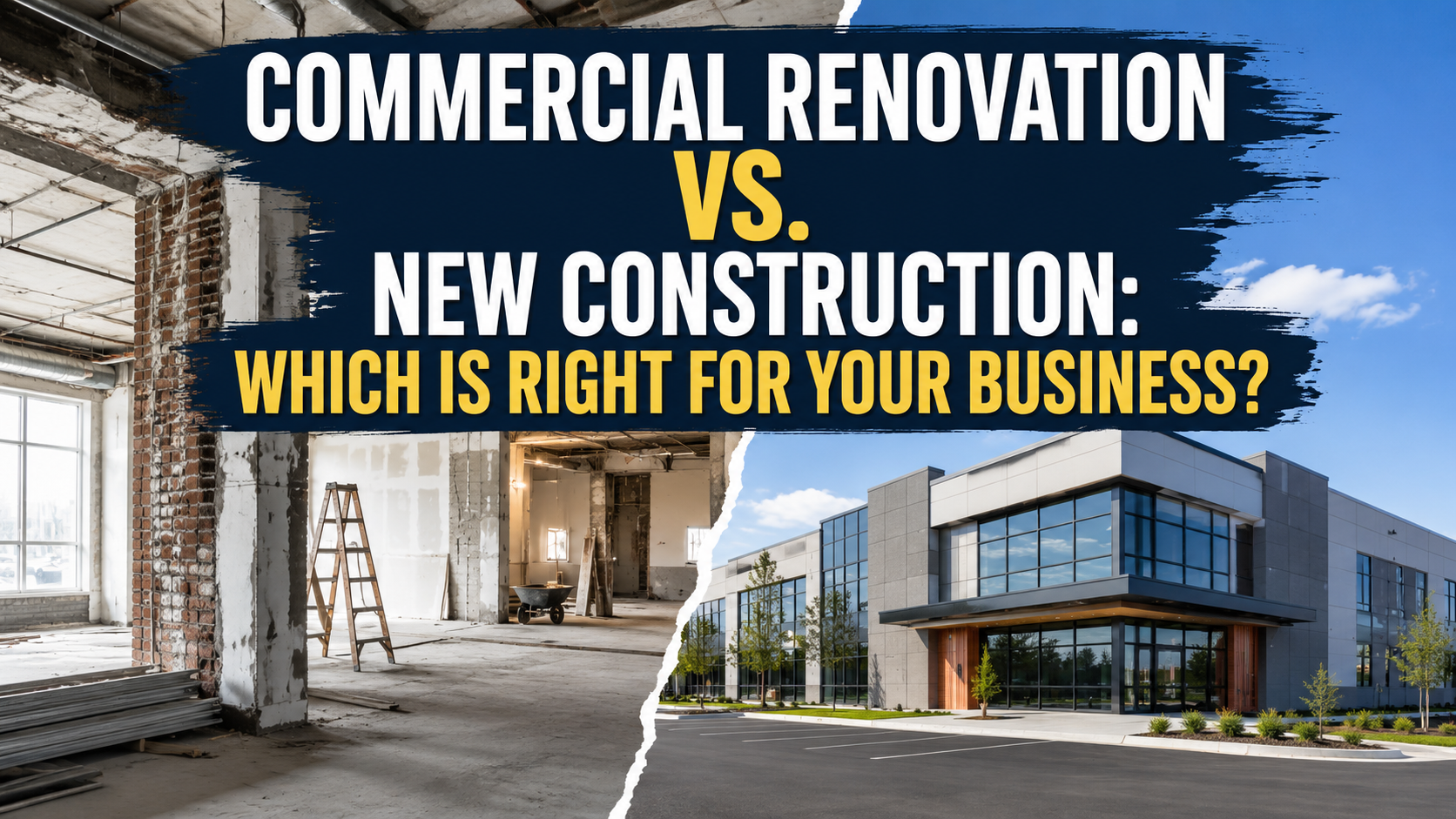
When your business needs more space, a better layout, updated facilities, or an entirely different type of building, one of the biggest decisions you will face is whether to renovate an existing commercial property or start from the ground up with new construction. Both approaches can create an excellent space for your company, but the right choice depends on your budget, timeline, property, business requirements, and long-term plans.
For business owners and commercial property owners in Gainesville, Florida, there are additional factors to consider. The condition of existing buildings, available land, permitting requirements, future growth, and the demands of Florida’s climate can all influence your decision.
Understanding the advantages and challenges of commercial renovation and new construction can help you determine which approach makes the most sense for your project.
What Is a Commercial Renovation?
Commercial renovation involves improving, modifying, or modernizing an existing commercial building. Depending on the project, renovations can range from relatively simple interior updates to extensive construction that changes most of the building.
A commercial renovation might involve creating a new floor plan, replacing flooring and ceilings, updating restrooms, improving accessibility, installing new lighting, upgrading electrical systems, replacing HVAC equipment, or completely transforming an outdated interior.
Renovations are common when a business purchases or leases a property that is in a good location but does not currently meet its needs.
For example, an existing retail space might be converted into an office, or an older office building may need extensive improvements before a growing company can move into it.
The key difference is that the primary structure already exists. Instead of starting with an empty piece of land, contractors work with the building that is already there.
What Is New Commercial Construction?
New commercial construction involves building a commercial property from the ground up.
The project typically begins with a piece of land and progresses through planning, design, site preparation, foundations, structural construction, mechanical systems, interior finishes, inspections, and final completion.
New construction gives businesses considerably more control over the finished property. Rather than adapting an existing building to your needs, the building can be designed around the way your organization actually operates.
This can be especially valuable for businesses that require specialized layouts, equipment, loading areas, parking arrangements, storage facilities, or other features that may be difficult to incorporate into an existing structure.
Consider the Condition of the Existing Building
One of the first questions to ask is whether you already have access to a building that is worth renovating.
A structurally sound commercial property in the right location can be an excellent candidate for renovation. If the foundation, structural components, roof, and major building systems are in reasonable condition, updating the property may be more practical than starting over.
However, appearances can sometimes be misleading.
An older building may have problems hidden behind walls, above ceilings, or underneath floors. Aging electrical systems, plumbing problems, roof leaks, moisture damage, inefficient HVAC equipment, structural deterioration, and outdated building components can significantly expand the scope of a renovation.
A thorough assessment of the property before construction begins can help identify these issues and determine whether renovation remains a practical option.
Compare the Overall Project Costs
Cost is naturally one of the biggest considerations for any commercial construction project.
Renovation can sometimes cost less because much of the existing structure can be reused. Foundations, exterior walls, structural framing, utilities, parking areas, and other components may already be in place.
However, renovating an existing building is not automatically cheaper.
Extensive demolition, structural modifications, outdated utilities, water damage, code upgrades, and unexpected problems can quickly increase renovation costs. Contractors may also have to work around existing structural elements, which can make certain improvements more complicated.
New construction generally requires a larger initial investment because the entire building must be constructed. There may also be expenses related to land acquisition, site development, drainage, utilities, parking, landscaping, and other infrastructure.
The best comparison is not simply renovation cost versus construction cost. Businesses should consider the total investment required to create a property that meets their needs and supports their long-term goals.
Think About Your Construction Timeline
Your desired completion date can also influence the decision.
Renovating an existing commercial building may provide a faster path to occupancy when the required changes are relatively straightforward. If the building is structurally sound and the project mainly involves interior improvements, renovation can sometimes move considerably faster than ground-up construction.
Major renovations, however, can still require extensive planning and construction.
New commercial construction typically requires more steps. Site preparation, foundations, structural work, exterior construction, utilities, interior construction, inspections, and other phases must all be completed before the building can open.
Businesses working toward a specific opening date should discuss scheduling early in the planning process.
Determine How Specialized Your Building Needs to Be
Every business uses its building differently.
A professional office has very different requirements from a restaurant, warehouse, medical facility, retail store, manufacturing operation, or automotive business.
If your needs are relatively standard, an existing building may be easy to adapt through renovation. Walls can often be moved, offices created, finishes updated, and mechanical systems modified to accommodate a new tenant.
Highly specialized operations may benefit more from new construction.
Starting from scratch allows architects, engineers, contractors, and business owners to design the property around workflow, equipment, employees, customers, deliveries, storage, utilities, and future expansion.
Instead of asking, “How can we make our business fit this building?” you can ask, “What building would work best for our business?”
That difference can be significant over the lifetime of the property.
Evaluate the Importance of Location
Location can sometimes make renovation the obvious choice.
You may find an existing commercial property in an ideal area of Gainesville where vacant land is limited or where a new development would be difficult to replicate.
For retail businesses, restaurants, professional offices, and other customer-facing companies, maintaining a desirable location can outweigh some of the disadvantages associated with renovating an older building.
Existing properties may also already have parking, utility connections, road access, landscaping, and other infrastructure.
New construction provides greater flexibility in building design, but finding suitable commercial land in the exact area you want may be more challenging.
Your decision should therefore consider the value of the location as well as the condition of the building itself.
Consider Building Codes and Accessibility Requirements
Renovating an older commercial property can involve more than simply updating its appearance.
Depending on the project, renovations may trigger requirements to bring portions of the building into compliance with current building, fire, electrical, plumbing, energy, and accessibility standards.
This can affect everything from entrances and restrooms to electrical systems and emergency exits.
These improvements are important for safety and accessibility, but they can also add to the project’s scope and budget.
New construction is designed around current requirements from the beginning. While this does not eliminate the complexity of permitting and inspections, it allows compliance requirements to be incorporated into the original plans rather than adapted to an older structure.
Think About Energy Efficiency and Operating Costs
Construction costs are only one part of what a commercial building will cost your business.
Monthly operating expenses matter too.
Older buildings may have inefficient HVAC systems, outdated insulation, older windows, air leaks, inefficient lighting, and other issues that increase energy consumption.
A commercial renovation provides an opportunity to address many of these problems. HVAC equipment can be upgraded, lighting can be replaced, insulation can be improved, and other energy-saving improvements can be incorporated into the project.
New construction offers the advantage of designing the entire building with modern energy efficiency in mind.
For a property you expect to occupy for many years, considering long-term operating costs can be just as important as comparing initial construction estimates.
Plan for Future Business Growth
A commercial building should work for your company today without unnecessarily limiting where the business can go tomorrow.
Before choosing renovation or new construction, consider what your operation may look like five, ten, or even twenty years from now.
Will you need additional offices? More warehouse space? Additional parking? Larger customer areas? More equipment? Increased electrical capacity?
An existing property may meet your current needs but offer little opportunity for expansion.
New construction can sometimes make future growth easier because expansion can be considered during the original design process.
However, a well-located existing property with additional usable space may provide just as much flexibility.
The important thing is to think beyond your immediate construction needs.
Understand the Possibility of Unexpected Conditions
One of the biggest differences between renovation and new construction is predictability.
Commercial renovations involve working with an existing building, and contractors cannot always see everything before work begins.
Once demolition starts, previously hidden problems may be discovered. These could include water damage, deteriorated materials, outdated wiring, plumbing problems, structural concerns, or previous construction that was completed differently than expected.
Proper inspections and preconstruction planning can reduce surprises, but they cannot always eliminate them.
New construction generally offers greater predictability because the building is being created from known plans and specifications. Ground conditions, weather, material availability, and other issues can still affect a project, but there are typically fewer unknown conditions hidden inside an existing structure.
When Does Commercial Renovation Make Sense?
Renovation may be the better choice when you have found a property in an excellent location, the existing structure is in good condition, and the building can reasonably be adapted to your needs.
It can also make sense when your business already owns a building that has become outdated but remains fundamentally suitable for your operation.
A carefully planned renovation can transform an aging commercial property without requiring the investment and timeline associated with starting completely from scratch.
When Does New Commercial Construction Make Sense?
New construction may be the better option when your business has highly specific building requirements, existing properties cannot provide the layout you need, or you want maximum control over the design.
It can also be attractive for companies planning to remain in the same facility for many years.
Building from the ground up provides an opportunity to consider workflow, technology, energy efficiency, accessibility, parking, customer experience, storage, and future expansion as part of one coordinated design.
Choosing the Right Approach for Your Gainesville Business
There is no universal answer to the renovation-versus-new-construction question.
A relatively small renovation of a well-maintained building may be significantly more practical than building a new facility. On the other hand, trying to force an outdated or poorly configured property to accommodate a specialized business can become expensive and limiting.
The best decision starts with understanding the property, defining your business requirements, establishing a realistic budget, and evaluating your long-term plans.
Gainesville Commercial Contractors can help business owners and commercial property owners evaluate their options and plan projects ranging from renovations and build-outs to ground-up commercial construction.
With the right planning and an experienced commercial construction team, both renovation and new construction can provide a space designed to serve your business for years to come.